Soft Summer: Your Complete Colour Guide
- Soft Summer: Your Complete Colour Guide
- Part 1: What Being a Soft Summer Actually Means
- Part 2: Your Power Palette — Best Colours (and Why)
- Part 3: The “Handle With a Little Extra Care” List
- Part 4: Pattern Play — Best Prints & Patterns (and Why)
- Part 5: Metal Detector — Best Metals & Jewellery (and Why)
- Part 6: Face Value — Your Makeup Roadmap
- Part 7: Through the Looking Glass — Eyewear
- Part 8: Crowning Glory — Hair Colour
- Part 9: Fingertips — Nail Polish
- Part 10: Texture & Fabric Talk
- Part 11: Putting It All Together — Styling Tips
- Part 12: Common Pitfalls (a.k.a. “Oh, That’s Why”)
- “Soft means everything should be beige.”
- “Muted means washed out.”
- “I’m near Autumn, so all earth tones should work.”
- Choosing Colours That Are Too Bright
- Choosing Colours That Are Too Dark
- Choosing Colours That Are Too Pale
- Defaulting to Black
- Buying Warm “Basics”
- Over-Muting Everything
- Avoiding All Contrast
- Forgetting Personal Style
- Quick-Reference Cheat Sheet
- A Final Word
So, the results are in: you’re a Soft Summer!
Which means your colouring has all the cool, blended elegance of Summer, but with an added layer of softness — the visual equivalent of lowering the volume without switching the music off.
Your palette is calm, nuanced, and beautifully understated. Not dull. Not washed out. Not permanently dressed in the colours of a waiting-room carpet from 1987. Your colours still have personality; they simply prefer an interesting conversation to shouting across the room.
Soft Summer sits firmly within the Summer family, meaning your colouring is fundamentally:
- Cool-neutral in undertone
- Medium in overall value
- Soft and muted in chroma
But because you sit closer to Autumn than the other Summer palettes do, you can borrow a little of Autumn’s earthiness and warmth. Your best colours remain cooler, greyer, and more blended than true Autumn shades, but they have more depth and groundedness than the lightest or clearest Summer colours.
Think dusty rose rather than bubblegum pink. Eucalyptus rather than mint. Mulberry rather than bright raspberry. Smoky teal rather than tropical turquoise. Soft, but substantial.
The goal is not to turn you into an Autumn. Autumn colours can become too warm, golden, orange, or richly saturated against you. Instead, you borrow just enough of Autumn’s depth and earthiness to give your Summer palette a softly grounded quality.
In other words: cool-neutral, muted, elegant, and quietly rich.
Let’s get into what that actually means for your wardrobe.
Part 1: What Being a Soft Summer Actually Means
Colour analysis looks at three main things about your natural colouring — your skin, hair, and eyes working together:
- Temperature — are your undertones warmer or cooler?
- Value — is your overall colouring lighter or deeper?
- Clarity — is your colouring clearer and more vivid, or softer and more muted?
For you, the strongest and most important quality is softness.
Your natural colouring tends to have a blended, low-contrast appearance. The features may flow gently into one another rather than creating very sharp distinctions between skin, hair, eyes, brows, and lips.
This does not mean your colouring lacks definition. It means definition appears more naturally through subtle shifts than dramatic contrast.
Your best colours contain a visible amount of grey, taupe, or softness. They look slightly weathered, misted, smoked, powdered, or toned down rather than bright and highly saturated.
A vivid colour may appear to sit on top of you. A softened version of that same colour tends to settle in and harmonise.
Your second important quality is your cool-neutral temperature.
You belong to the Summer family, so your palette leans cool. Blue, rose, mauve, lavender, blue-green, and cool grey undertones tend to suit you naturally.
However, your proximity to Autumn gives you a little more neutrality and warmth than the coolest Summer palettes. You may wear some softly warm colours — especially rose-beige, muted coral, soft camel-taupe, or gentle olive-grey — provided they remain muted and do not become strongly golden, orange, or yellow.
A softened rose-brown may work beautifully. Pumpkin orange remains highly committed to someone else’s wardrobe.
Your third quality is your medium value.
You are not restricted to very light pastels, and you do not generally need extremely deep colours. Your easiest range sits around the middle of the scale, with room to move somewhat lighter or darker as long as the colour stays softened.
You can wear:
- Dusty light colours
- Medium smoky colours
- Softened dark accents
- Gentle tonal combinations
The difficulty usually begins when a shade becomes either extremely pale and icy or very dark and blackened.
Here is the easiest way to picture your palette:
Imagine a Summer landscape viewed through a fine veil of mist.
The colours are still there — rose, blue, green, plum, teal — but nothing is sharp-edged or glaring. Everything looks gently blended, slightly greyed, and beautifully calm.
A few other things worth knowing:
- Soft Summer can appear across many skin tones, hair colours, and eye colours. It is not a single “look”.
- Soft does not mean pale. Mulberry, smoky navy, muted teal, and soft aubergine can all belong in your palette.
- Muted does not mean lifeless. Your colours still contain pigment; they simply avoid extreme saturation.
- Your Autumn influence is useful, but it is not the whole story. You can borrow some earthiness and warmth, but strong rust, mustard, orange, and golden brown may overwhelm you.
- Clarity usually matters before temperature. A slightly warm muted colour may work better than a perfectly cool neon one.
The central rule is simple:
Keep it softened, keep it balanced, and stop before the colour becomes either too bright or too earthy.
Part 2: Your Power Palette — Best Colours (and Why)
The unifying theme of your palette is soft, blended colour with cool-neutral depth.
Your best shades look as though they have been mixed with a little grey, taupe, or mist. They are not chalky, neon, sharply contrasting, or intensely dark.
They look refined, quiet, and gently complex.
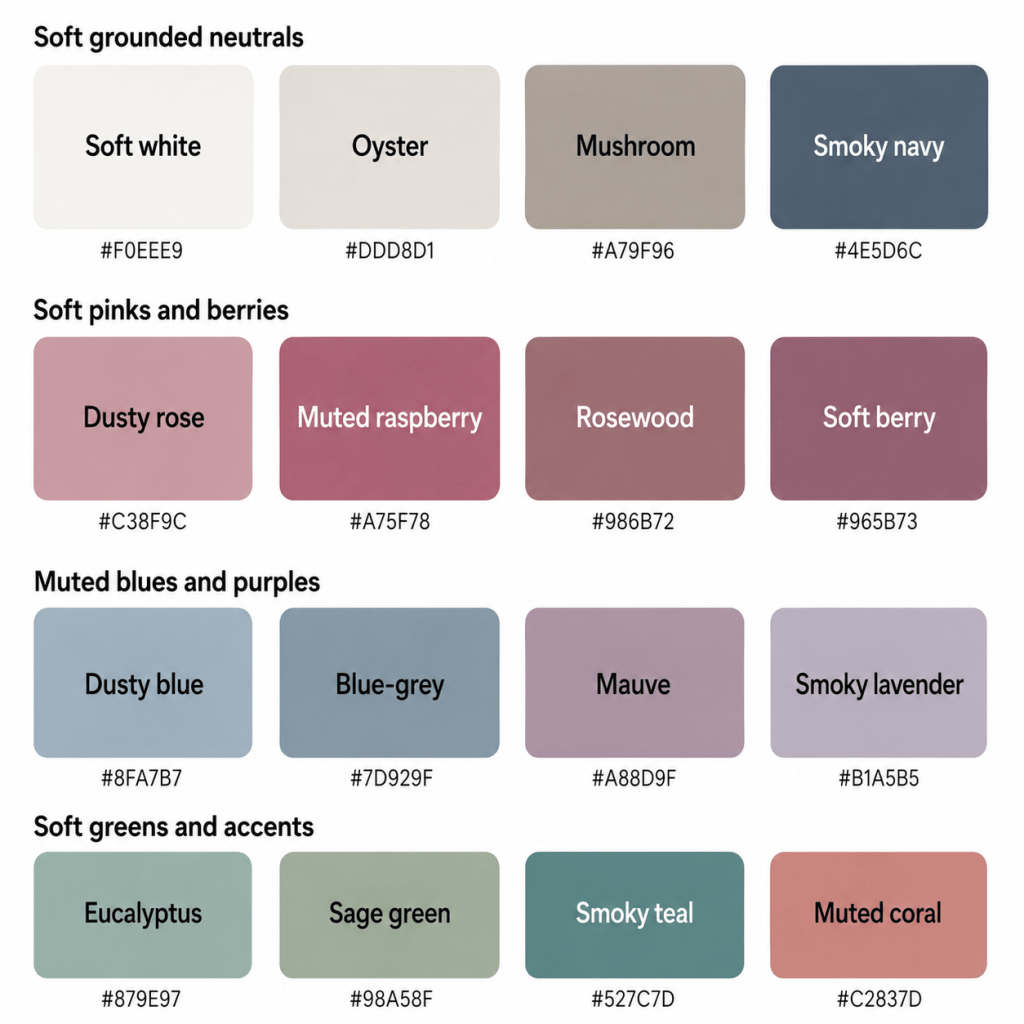
The Soft, Grounded Neutrals
- Soft White — gentle and slightly muted, without the starkness of optic white
- Oyster — a soft greyed off-white with a cool-neutral quality
- Dove Grey — one of your easiest light neutrals
- Mushroom — a soft grey-brown that avoids obvious warmth
- Rose Taupe — a muted pink-brown neutral
- Smoky Navy — softened navy without deep inky intensity
These neutrals work because they echo your blended colouring.
Soft white is usually more harmonious than brilliant white. Dove grey provides structure without harshness. Mushroom and rose taupe bring in the grounded quality you borrow from Autumn while remaining muted and neutral enough to sit comfortably within Summer.
Smoky navy is one of your best dark anchors. It gives you the function of black without creating the same hard edge.
You may also suit:
- Pewter
- Blue-grey
- Cool cocoa
- Soft charcoal
- Greyed mauve
- Muted aubergine used as a neutral
Rose taupe is a neutral. Nobody needs to alert beige.
Soft Pinks & Reds
- Dusty Rose
- Muted Raspberry
- Rosewood
- Soft Berry
- Mauve Pink
- Mulberry
- Muted Cranberry
- Rose Brown
Your pinks and reds should feel blended rather than bright.
Dusty rose is especially useful because it carries enough colour to enliven the face while still mirroring your softness. Muted raspberry gives you more presence without becoming vivid. Rosewood and rose brown offer earthy alternatives that reflect your Autumn influence without becoming orange.
Mulberry and soft berry work beautifully when you need a deeper accent. They provide richness, but the greyed quality prevents them from becoming too dramatic.
Avoid very hot pinks, neon magentas, orange-reds, and glossy cherry shades. These may appear separate from you rather than connected.
Your reds should look as though they have been mixed thoughtfully, not plugged into the mains.
Blues
- Dusty Blue
- Blue-Grey
- Soft Denim
- Slate Blue
- Muted Cornflower
- Smoky Periwinkle
- Soft Navy
- Storm Blue
Blue is one of your strongest colour families, provided it remains softened.
Dusty blue and blue-grey are natural everyday choices. Soft denim is practical and easy to combine. Slate blue gives you more depth, while muted cornflower adds freshness without becoming too clear.
Storm blue and smoky navy provide excellent darker options. They remain recognisably blue but carry enough grey to avoid looking hard.
Look for denim that appears:
- Softly faded
- Blue-grey
- Medium wash
- Low contrast
- Free from strong yellow or orange distressing
Very dark indigo may become heavy, while highly bleached ice-blue denim may feel too stark.
Purples
- Mauve
- Heather
- Smoky Lavender
- Muted Orchid
- Plum
- Soft Aubergine
- Mulberry
- Greyed Violet
Purple is often particularly harmonious because it combines cool blue and red while naturally lending itself to muted versions.
Mauve and heather make excellent everyday colours. Smoky lavender gives you a lighter option without becoming sugary. Plum and soft aubergine provide depth while remaining softer than black or very dark navy.
Be cautious with vivid royal purple, bright violet, or extremely icy lilac.
Your best purples have a slightly smoky, greyed, or brown-softened quality — sophisticated rather than theatrical.
Greens & Blue-Greens
- Eucalyptus
- Sage Green
- Smoky Teal
- Soft Pine
- Greyed Jade
- Muted Sea Green
- Soft Olive
- Blue Spruce
Green is a particularly useful family for Soft Summer because it can reflect both Summer coolness and Autumn earthiness.
Eucalyptus, sage, and muted sea green are beautifully balanced everyday shades. Smoky teal gives you more depth and colour. Blue spruce and soft pine provide darker accents without becoming blackened.
Some olive shades may work because of your Autumn influence, but they should remain cool, greyed, and restrained. Avoid olive that becomes strongly yellow, brown, or military-khaki.
You want the kind of olive that has been quietly contemplating life beside a eucalyptus tree.
Muted Warm-Leaning Colours
Your Autumn influence allows a limited range of softly warm colours, provided they remain low in chroma.
Try:
- Muted Coral
- Rose Beige
- Soft Peach-Rose
- Dusty Apricot
- Muted Camel
- Soft Cinnamon-Rose
These colours should be:
- Greyed
- Gentle
- Rose-based
- Neutral rather than golden
- Softly warm rather than orange
A muted coral may work beautifully. A bright tropical coral may look as though it arrived with its own cocktail umbrella.
Soft Light Colours
- Powder Pink
- Mist Blue
- Soft Lavender
- Pale Sage
- Rose Beige
- Oyster
- Muted Aqua
- Pale Blue-Grey
Your lighter colours should remain softly greyed rather than icy or chalky.
Very clear pastels may look too sweet or bright. Extremely pale icy shades may create more contrast than your colouring needs.
Your best light colours are:
- Gentle
- Slightly smoky
- Low in contrast
- Clearly coloured
- Softened rather than bleached
Think morning mist, not highlighter pen.
A Starter Palette
| Colour | Hex | Notes |
|---|---|---|
| Soft White | #F0EEE9 | Gentle, muted white |
| Oyster | #DDD8D1 | Soft cool-neutral off-white |
| Dove Grey | #B7B8B6 | Balanced light grey |
| Mushroom | #A79F96 | Soft grey-brown |
| Rose Taupe | #A98F8F | Muted rosy neutral |
| Smoky Navy | #4E5D6C | Softened dark anchor |
| Dusty Rose | #C38F9C | Soft everyday pink |
| Muted Raspberry | #A75F78 | Rich but restrained |
| Rosewood | #986B72 | Grounded muted red |
| Soft Berry | #965B73 | Cool, softened berry |
| Mulberry | #775366 | Deep without harshness |
| Muted Cranberry | #9D5969 | Soft blue-red |
| Dusty Blue | #8FA7B7 | Gentle cool blue |
| Blue-Grey | #7D929F | Muted everyday blue |
| Slate Blue | #6E7F96 | Structured medium blue |
| Muted Cornflower | #7F99B9 | Fresh but softened |
| Smoky Periwinkle | #9295B0 | Greyed blue-violet |
| Storm Blue | #5E7080 | Deep, misty blue |
| Mauve | #A88D9F | Soft purple-pink |
| Heather | #96849A | Muted violet neutral |
| Smoky Lavender | #B1A5B5 | Gentle light purple |
| Plum | #745B70 | Softened depth |
| Eucalyptus | #879E97 | Cool muted green |
| Sage Green | #98A58F | Gentle green neutral |
| Smoky Teal | #527C7D | Rich blue-green |
| Blue Spruce | #526F70 | Deep, calm green |
| Greyed Jade | #78978C | Balanced cool green |
| Muted Coral | #C2837D | Soft rose-coral |
Part 3: The “Handle With a Little Extra Care” List
This is not a list of colours you must throw away while standing dramatically beside a donation bin in the rain.
These are simply colours that sit further away from your natural combination of softness, cool-neutral temperature, and medium value. They may require more thoughtful styling, especially near your face.
The Brightest Colours
- Neon pink
- Electric blue
- Vivid turquoise
- Hot magenta
- Acid green
- Bright orange
- Brilliant scarlet
- Highly saturated jewel tones
Brightness is often your biggest challenge.
Highly saturated colours may overwhelm your blended colouring and make your features appear faded by comparison.
The issue is not that the colour is “too colourful”. It is that it has more visual intensity than your colouring naturally reflects.
Choose:
- Muted raspberry instead of hot pink
- Dusty blue instead of electric blue
- Smoky teal instead of vivid turquoise
- Soft berry instead of magenta
- Sage instead of acid green
A bright colour may wear you. A softened version is far more likely to cooperate.
Stark Black and White
- Jet black
- Optic white
- High-gloss black
- Pure black-and-white combinations
- Very dark charcoal
- Near-black navy
Stark neutrals can create a hard edge against your softer colouring.
Black may appear heavy, while optic white may feel sharp or draining. The combination of the two can create more contrast than you naturally carry.
Better options include:
- Smoky navy
- Soft charcoal
- Dove grey
- Oyster
- Soft white
- Mushroom
- Pewter
If you already own black, soften it with:
- A dusty rose scarf
- A smoky blue blouse
- Soft silver jewellery
- Muted berry lipstick
- An oyster neckline
There is no need to exile black. It may simply require a chaperone.
The Warmest Autumn Colours
- Pumpkin
- Burnt orange
- Rust
- Mustard
- Golden brown
- Copper
- Terracotta
- Warm camel
- Deep olive
- Marigold
Your Autumn influence gives you access to some earthier colours, but the strongest Autumn shades may become too warm and saturated.
Choose:
- Rosewood instead of rust
- Muted coral instead of orange
- Mushroom instead of camel
- Soft olive instead of golden olive
- Rose taupe instead of cognac
- Muted cranberry instead of brick red
The colour should look weathered and balanced, not freshly harvested.
The Iciest Colours
- Frosty white
- Icy blue
- Icy pink
- Very pale lavender
- Bright mint
- Near-white pastels
Extremely icy colours can feel too clear, pale, and sharp.
You may wear light colours, but they usually need a little grey or depth to connect naturally with your colouring.
Choose:
- Powder pink instead of icy pink
- Mist blue instead of frost blue
- Smoky lavender instead of icy lilac
- Pale sage instead of bright mint
- Oyster instead of optic white
Very Dark, Blackened Colours
- Black cherry
- Near-black aubergine
- Espresso
- Blackened forest green
- Oxblood
- Deep burgundy
- Midnight navy
You can wear some depth, but very dark colours may create too much visual weight.
Use plum, smoky navy, blue spruce, soft aubergine, or cool cocoa instead.
Very dark colours are easier in:
- Shoes
- Handbags
- Trousers
- Small accessories
- Patterns containing softer shades
- Evening outfits with balanced makeup
Extremely Muddy Colours
Softness is your strength, but there is still such a thing as too much grey.
Be cautious with:
- Lifeless beige-grey
- Murky khaki
- Browned mustard
- Very muddy olive
- Faded brown-mauve
- Grey that turns sallow
- Colours that have misplaced their entire identity
Your colours should be muted, not defeated.
If a shade makes you look tired, choose a version with slightly more visible pigment.
How to Make a Less-Ideal Colour Work
You have several options:
- Move it away from your face
- Pair it with one of your best muted colours
- Use it in a smaller proportion
- Choose a softer version of the same hue
- Add silver, pewter, or softly mixed-metal jewellery
- Place a dusty rose, smoky blue, or sage neckline between you and the colour
- Use it in shoes, bags, trousers, or patterned garments
- Lower the contrast of the rest of the outfit
The goal is not wardrobe obedience. It is understanding why something feels too bright, too warm, too stark, or too heavy — and knowing how to bring it back into balance.
Part 4: Pattern Play — Best Prints & Patterns (and Why)
Soft Summer patterns work best when they reflect the same balance found in your solid colours:
- Low-to-medium contrast
- Muted colour
- Cool-neutral temperature
- Blended edges
- Medium overall value
- Gentle complexity rather than sharp drama
What Works for You
Low-Contrast Patterns
Think:
- Dove grey and dusty blue
- Mushroom and rose taupe
- Mauve and plum
- Eucalyptus and sage
- Oyster and muted raspberry
These combinations create visual interest without overpowering your natural softness.
Tonal Patterns
Tonal patterns use several versions of a similar colour:
- Dusty blue, slate, and smoky navy
- Dusty rose, rosewood, and mulberry
- Sage, eucalyptus, and blue spruce
- Mauve, heather, and plum
These can be especially flattering because the colours blend gently while still creating depth.
Watercolour and Blurred Prints
Watercolour florals, brushed abstracts, and softly blended motifs are natural fits.
Look for:
- Soft edges
- Overlapping colours
- Misty backgrounds
- Greyed outlines
- Low contrast
- Visible but restrained pigment
A print in mauve, sage, smoky blue, and rose taupe can look beautiful.
A print where every colour has dissolved into a brownish puddle may have taken the concept slightly too far.
Soft Florals
Excellent florals include:
- Dusty roses
- Muted hydrangeas
- Lavender-grey petals
- Blue-green leaves
- Plum accents
- Oyster or smoky backgrounds
Be cautious with florals dominated by:
- Bright tropical colours
- Orange flowers
- Mustard leaves
- Black backgrounds
- Stark white outlines
- High-contrast botanical prints
Subtle Geometrics
Try:
- Soft checks
- Blended stripes
- Small-scale herringbone
- Muted polka dots
- Greyed abstract geometrics
- Tonal plaid
Crisp black-and-white geometrics may become too sharp, but softened versions in navy, mushroom, grey, and rose can work beautifully.
Animal Prints
Traditional leopard may be too warm and high in contrast, but softened versions can work:
- Grey-taupe leopard
- Mushroom-and-charcoal snake print
- Blue-grey animal print
- Rose-taupe abstract markings
- Soft olive and grey
- Muted plum animal print
You may wear animal print. The animal simply needs to look as though it has developed excellent emotional regulation.
Patterns Worth a Second Look
- Stark black-and-white prints
- Neon multicoloured patterns
- Very bright tropical florals
- High-contrast stripes
- Sharp graphic motifs
- Warm orange-and-brown animal prints
- Extremely dark backgrounds
- Very crisp colour blocking
- Colours that are muddy rather than softly blended
Pattern Scale
Colour analysis does not determine pattern scale on its own; your facial features, body proportions, personal style, and garment shape also matter.
However, your muted colouring often works well with:
- Small-to-medium florals
- Softly layered patterns
- Fine checks
- Blended abstract prints
- Medium motifs with gentle edges
- Patterns without extreme spacing or contrast
The pattern does not need to whisper, but it probably should not arrive carrying a megaphone and a laminated agenda.
Part 5: Metal Detector — Best Metals & Jewellery (and Why)
Your undertone is cool-neutral, while your Autumn influence gives you slightly more flexibility with softly warm and mixed metals.
Best Metals
- Silver
- White gold
- Platinum
- Pewter
- Brushed steel
- Antique silver
- Soft rose gold
- Muted champagne gold
- Mixed metals in softened finishes
Silver remains one of your easiest options because it reflects your coolness without adding harsh contrast.
Pewter, antique silver, and brushed steel are particularly strong because their softened finishes echo your low chroma.
Soft rose gold may also work, especially when it leans pink or taupe rather than copper.
Muted champagne gold can be flattering when it is pale, gentle, and not strongly yellow.
Finish Matters
Your palette tends to favour:
- Brushed metal
- Satin finishes
- Hammered textures
- Antique finishes
- Soft lustre
- Frosted surfaces
- Subtle patina
- Gentle sparkle
Very shiny, mirror-polished metal may appear too bright, while extremely dark oxidised metal can become heavy.
Your jewellery does not need to look as though it has spent six centuries beneath a castle, but a little softness usually helps.
Yellow Gold
Yellow gold is easiest when it is:
- Pale
- Muted
- Brushed
- Lightly antique
- Combined with cool stones
- Small or delicate in scale
Be more careful with:
- Bright yellow gold
- Rich orange gold
- High-shine brass
- Deep bronze
- Copper
Your Autumn influence allows some gold, but the finish matters greatly.
A softly brushed gold chain may blend beautifully. A large, mirror-polished yellow-gold collar may begin issuing statements on your behalf.
Rose Gold
Your best rose gold is:
- Muted
- Pink-taupe
- Soft
- Not overly peach
- Brushed rather than highly polished
Copper-heavy rose gold may be too warm.
Mixed Metals
Mixed metals can work particularly well because your temperature sits near neutral.
Try:
- Silver and soft gold
- Pewter and rose gold
- Brushed steel and champagne gold
- Antique silver with muted brass details
Keeping the finishes softened helps the combination feel deliberate rather than busy.
Gemstones
Excellent options include:
- Moonstone
- Labradorite
- Pearl
- Grey pearl
- Rose quartz
- Smoky amethyst
- Aquamarine
- Muted sapphire
- Blue-grey topaz
- Soft garnet
- Mauve tourmaline
- Moss agate
- Opal
- Fluorite
- Muted turquoise
Your best stones tend to be:
- Cloudy
- Softly translucent
- Greyed
- Mixed in colour
- Gently reflective
- Medium in depth
Very clear, brilliant gemstones may feel too sharp, while extremely dark stones may become heavy.
Pearls in grey, lavender, rose, soft white, and blue-grey are especially harmonious.
They seem to understand the assignment without needing several follow-up emails.
Part 6: Face Value — Your Makeup Roadmap
Your most flattering makeup enhances your softness, cool-neutral undertone, and medium depth without becoming harsh, bright, or overly warm.
The goal is gentle definition.
You do not need to erase every visible feature beneath beige powder and call it “natural”. Soft makeup can still contain colour, structure, and rather a lot of quiet competence.
Foundation & Concealer
Look for foundation undertones described as:
- Neutral
- Cool-neutral
- Rosy-neutral
- Muted cool
- Neutral beige
- Soft olive-neutral, where appropriate
Some Soft Summers lean clearly cool, while others sit closer to neutral because of their Autumn influence.
Strongly pink formulas may be too rosy for some people, while golden, peach, and orange formulas may become visibly warm.
Always test the actual product rather than trusting the shade name.
“Neutral linen” may sound calm and sensible while emerging from the tube looking suspiciously apricot. Foundation naming remains a loosely supervised activity.
Avoid formulas that turn:
- Yellow
- Orange
- Peach
- Strongly golden
- Warm olive
- Ashy or chalky
Natural, satin, soft-matte, and softly luminous finishes often work beautifully.
Very flat matte finishes can make the complexion look dull, while intense wet-look shine may create more contrast than your colouring needs.
Blush
Best blush colours include:
- Dusty rose
- Mauve pink
- Rosewood
- Muted berry
- Soft plum
- Rose beige
- Muted coral
- Pink-brown
Dusty rose is one of your most reliable everyday choices. Mauve pink and rose beige create subtle definition. Muted berry and soft plum add more depth for evening or deeper skin tones.
Be cautious with:
- Bright coral
- Orange peach
- Terracotta
- Hot pink
- Vivid red
- Golden bronze blush
A blush should look as though it belongs in your skin, not as though it has been placed on top with a small trowel.
Bronzer & Contour
Traditional golden bronzers can be difficult because they often become too orange or saturated.
Try:
- Cool taupe
- Rose taupe
- Neutral mushroom
- Soft cocoa
- Muted beige-brown
- Grey-brown
- Neutral bronzer with low saturation
Your Autumn influence may allow a little warmth, but it should remain soft and neutral.
Contour shades should mimic natural shadow:
- Cool taupe
- Mushroom
- Grey-brown
- Muted cocoa
- Rose-brown
Avoid:
- Orange bronzer
- Caramel
- Red-brown
- Golden tan
- Deep chocolate contour
The goal is soft dimension, not the creation of entirely new cheekbones under emergency conditions.
Lips
Your best lip colours are muted, cool-neutral, and medium in depth.
Try:
- Dusty rose
- Mauve pink
- Rosewood
- Soft berry
- Muted raspberry
- Mulberry
- Plum-rose
- Rose brown
- Muted cranberry
- Soft coral-rose
For a natural lip:
- Rose beige
- Mauve nude
- Pink-brown
- Soft berry balm
- Muted rose
- Cool taupe-pink
Your nude lipstick should contain enough rose, mauve, or pink-brown pigment to avoid looking flat.
Be cautious with:
- Peach nude
- Caramel nude
- Orange-red
- Bright cherry
- Neon pink
- Very dark burgundy
- Beige that matches your concealer with alarming precision
For a stronger lip, try mulberry, muted cranberry, or soft berry rather than a bright blue-red or blackened wine.
Eyes — Shadow
Excellent eyeshadow colours include:
- Mushroom
- Dove grey
- Cool taupe
- Rose taupe
- Mauve
- Heather
- Smoky lavender
- Plum
- Soft charcoal
- Blue-grey
- Slate
- Smoky teal
- Eucalyptus
- Muted navy
- Soft cocoa
For an everyday neutral eye, combine mushroom, rose taupe, and soft grey.
For more colour, try mauve, smoky teal, muted plum, or slate blue.
Your version of brown should be greyed, mushroom-based, rose-brown, or cool cocoa rather than caramel, copper, or orange-brown.
Eyes — Liner
Best eyeliner colours include:
- Charcoal
- Slate
- Smoky navy
- Plum
- Soft aubergine
- Deep teal
- Grey-brown
- Cool cocoa
- Pewter
Black eyeliner may create too much contrast, especially when applied thickly or sharply.
For everyday definition, charcoal, grey-brown, plum, or smoky navy usually creates a more harmonious effect.
A very crisp black wing may look impressive, but it may also appear to have been borrowed from another face.
Mascara
Try:
- Soft black
- Charcoal-black
- Brown-black
- Grey-black
- Plum-black
- Navy-black
The best choice depends on your natural contrast.
Black may work if your lashes and features already provide enough depth, but soft black or brown-black often looks more integrated.
Brows
Choose brow products that are:
- Ash blonde
- Cool taupe
- Mushroom
- Ash brown
- Grey-brown
- Soft charcoal
- Neutral brown
Avoid products with obvious:
- Red
- Auburn
- Copper
- Golden brown
- Orange
- Very dark black-brown
Brows should create soft structure rather than becoming two highly organised caterpillars holding a strategic meeting above your eyes.
Highlighter
Best highlighters include:
- Pearl
- Soft rose
- Muted champagne
- Icy taupe
- Opal
- Silver-beige
- Soft pink-grey
- Subtle lavender
Your highlighter should create a gentle sheen rather than a strip of metallic brightness.
Avoid:
- Strong yellow gold
- Copper
- Bright peach
- Bronze
- Highly reflective white
- Glitter-heavy finishes
A softly luminous finish tends to suit you better than molten foil.
Part 7: Through the Looking Glass — Eyewear
Eyewear sits directly on the face, so colour, contrast, and finish matter.
Your best frames are softly coloured, medium in depth, and blended rather than stark.
Best Frame Colours
- Rose taupe
- Mushroom
- Smoky navy
- Plum
- Mauve
- Dusty rose
- Blue-grey
- Slate
- Eucalyptus
- Smoky teal
- Soft charcoal
- Pewter
- Muted aubergine
- Cool cocoa
- Greyed tortoiseshell
Tortoiseshell
Soft Summer can often wear tortoiseshell particularly well when it is:
- Grey-brown
- Rose-taupe
- Soft cocoa
- Muted olive-grey
- Low contrast
- Free from bright orange or golden patches
Traditional high-contrast orange-and-black tortoiseshell may be too warm and busy.
Your ideal tortoiseshell should look softly marbled rather than as though it is recreating a small bonfire.
Transparent Frames
Transparent frames can work beautifully when they contain:
- Smoky rose
- Grey taupe
- Muted lavender
- Blue-grey
- Soft teal
- Rose brown
- Cool transparent olive
- Clear charcoal
Completely colourless frames may work, but a soft tint often creates more connection with your colouring.
Frame Contrast
Medium-to-low contrast frames are usually easiest.
Excellent choices include:
- Rose-taupe acetate
- Soft navy
- Pewter wire
- Mushroom transparent frames
- Mauve
- Greyed teal
- Muted plum
Darker frames can work when the shape is refined and the finish is softened.
Very thick jet-black frames may feel severe, while bright clear frames may appear too crisp.
Frames Worth a Second Look
- Glossy black
- Optic white
- Bright red
- Neon colours
- Orange tortoiseshell
- Yellow gold
- Copper
- Very clear jewel tones
- Extremely pale icy frames
Your glasses should frame your face gently, not begin a hostile takeover of the upper half.
Part 8: Crowning Glory — Hair Colour
Your most harmonious hair colours are soft, cool-neutral, and naturally dimensional.
Because hair surrounds the face, overly bright highlights, very dark solid colour, or obvious golden warmth can disrupt your blended colouring quickly.
Best Blonde Shades
- Ash blonde
- Mushroom blonde
- Cool beige blonde
- Dark ash blonde
- Taupe blonde
- Smoky blonde
- Muted pearl blonde
- Soft silver-beige
Your blonde should look natural and softly toned rather than extremely icy or strongly golden.
Very white platinum may be too stark, while honey and golden blonde may become too warm.
Avoid:
- Bright platinum
- Honey blonde
- Butterscotch
- Golden blonde
- Strawberry blonde
- Caramel-heavy highlights
Best Brunette Shades
- Ash brown
- Mushroom brown
- Cool medium brown
- Taupe brown
- Smoky brunette
- Soft cocoa
- Neutral-cool brown
- Rose brown
Brunette shades often work beautifully when they remain medium in depth and softly dimensional.
Avoid very dark espresso, blue-black, or warm chestnut unless your natural colouring already carries enough depth to support them.
Your best browns avoid obvious red, orange, copper, or golden tones.
Red Hair
Naturally occurring red hair can appear within many palettes, and the whole combination of skin, hair, and eyes determines the result.
For artificial red shades, Soft Summer generally suits:
- Muted rose brown
- Berry brown
- Soft burgundy-brown
- Cool auburn with minimal orange
- Mauve-brown
- Dusty rose-gold used subtly
Classic copper, vivid ginger, bright auburn, and orange-red are usually too warm or saturated.
The best red should look softened and complex rather than freshly polished.
Fashion Colours
Excellent creative hair colours include:
- Smoky lavender
- Dusty pink
- Mauve
- Blue-grey
- Muted plum
- Soft teal
- Silver
- Rose taupe
- Smoky blue
Choose colours that are muted rather than neon.
Dusty lavender may blend beautifully. Electric purple may immediately request its own dressing room.
Highlights & Balayage
Look for:
- Ash highlights
- Mushroom ribbons
- Cool beige dimension
- Taupe balayage
- Soft pearl pieces
- Smoky blonde accents
- Rose-beige highlights
- Gentle tonal contrast
Avoid:
- Bright blonde stripes
- Caramel balayage
- Golden ribbons
- Copper highlights
- Very high contrast
- Harsh dark roots with icy ends
Highlights should blend into the base rather than creating obvious bands.
Hair Depth
Your medium value gives you some flexibility, but extreme depth can still become heavy.
Before going dramatically darker, consider:
- Whether the colour sharpens shadows
- Whether your skin looks paler or duller
- Whether your eyes lose visibility
- Whether you need heavier makeup for balance
- Whether the hair appears before you do
Soft dimension is usually more harmonious than one solid, very dark shade.
A Note on Grey Hair
Natural grey, silver, and white hair can work beautifully, especially when it retains a soft, blended quality.
Excellent tones include:
- Pewter
- Dove grey
- Silver-grey
- Mushroom grey
- Soft white
- Blue-grey
- Charcoal-grey
- Rose-grey
Very bright white may create more contrast, but it can be balanced with softened clothing and makeup.
If grey hair begins to yellow, violet or blue-toning products may help maintain a cooler result when appropriate.
Grey does not make your palette less interesting. It may simply give your best colours a rather elegant new background.
Part 9: Fingertips — Nail Polish
Nail polish sits away from the face, so you have more flexibility, but your palette still provides an excellent shortcut.
Best Everyday Colours
- Dusty rose
- Mauve
- Rose taupe
- Mushroom
- Muted berry
- Soft plum
- Blue-grey
- Sage
- Eucalyptus
Light Colours
- Oyster
- Powder pink
- Mist blue
- Smoky lavender
- Pale sage
- Rose beige
- Soft grey
- Muted aqua
Medium Colours
- Muted raspberry
- Dusty blue
- Slate
- Smoky teal
- Rosewood
- Heather
- Greyed jade
Deeper Colours
- Mulberry
- Plum
- Smoky navy
- Blue spruce
- Soft aubergine
- Cool cocoa
- Muted cranberry
Deeper nail colours can go slightly darker than clothing colours because they cover a smaller area.
Nudes
Your best nude nail colours include:
- Rose beige
- Mauve nude
- Pink-brown
- Mushroom
- Cool taupe
- Grey-pink
- Soft cocoa nude
Avoid:
- Orange beige
- Caramel
- Peach nude
- Yellow cream
- Bright pink-beige
- Very chalky white nude
Metallic Nails
Try:
- Pewter
- Antique silver
- Rose gold
- Muted champagne
- Smoky lavender shimmer
- Blue-grey metallic
- Soft bronze-grey
Bright yellow gold, copper, and highly reflective chrome may feel too sharp or warm.
Sometimes the goal is elegant understatement. Sometimes the goal is fingernails that look like small, enchanted pebbles. Your palette can support both.
Part 10: Texture & Fabric Talk
Colour does most of the heavy lifting in seasonal analysis, but texture changes how bright, deep, muted, or contrasting a colour appears.
Soft Summer tends to suit fabrics that feel blended, tactile, gently textured, and softly reflective.
Fabrics That Flatter
- Cashmere
- Brushed cotton
- Fine wool
- Soft denim
- Suede
- Velvet
- Washed silk
- Crepe
- Linen blends
- Soft leather
- Mélange knits
- Lightweight tweed
- Chiffon
- Matte satin
- Jersey
Your Summer quality is reflected in softness and drape, while your Autumn influence allows a little more texture and earthiness.
A smoky-blue cashmere jumper, rose-taupe suede jacket, or eucalyptus linen-blend dress can all work beautifully.
Shine
You can handle:
- Soft satin
- Pearl finishes
- Brushed metallic thread
- Gentle shimmer
- Velvet lustre
- Frosted finishes
- Subtle sequins
- Softly polished leather
Be more cautious with:
- Mirror-finish sequins
- High-gloss patent leather
- Bright metallic lamé
- Glitter-heavy fabrics
- Very shiny black
- Neon gloss
The issue is not shine itself. It is how much intensity the shine adds.
Your palette likes a glow. It is less enthusiastic about being visible from the International Space Station.
Matte & Textured Fabrics
Textured fabrics can be especially flattering because they naturally soften colour.
Excellent options include:
- Brushed knits
- Tweed
- Suede
- Mélange wool
- Washed linen
- Soft corduroy
- Matte leather
- Heathered cotton
Be cautious with textures that are:
- Extremely rough
- Strongly rustic
- Deeply warm in colour
- Heavy and dark
- Very distressed
A soft mushroom tweed may be beautiful. A thick orange-brown blanket coat may begin telling a different seasonal story.
Structure
You can wear both draped and tailored shapes.
Your softness tends to suit:
- Relaxed tailoring
- Rounded edges
- Soft pleats
- Layered fabrics
- Gentle draping
- Blended textures
- Unstructured jackets
- Refined but unfussy details
Extremely sharp, rigid tailoring may feel more severe, especially in high-contrast colours.
Think polished without looking over-engineered.
Not dressed to deliver a quarterly performance review to everyone at brunch.
Part 11: Putting It All Together — Styling Tips
Knowing individual colours is useful. Knowing how to combine them turns your palette into a working wardrobe rather than a very attractive collection of paint samples.
Build Around Soft Neutrals
Choose two or three primary neutrals, such as:
- Smoky navy
- Dove grey
- Mushroom
- Rose taupe
- Soft white
- Pewter
These make it easy to combine your muted colours.
For example:
- Smoky navy + dusty rose + oyster
- Mushroom + eucalyptus + rosewood
- Dove grey + mauve + plum
- Rose taupe + dusty blue + soft white
- Pewter + muted raspberry + sage
Keep the Overall Contrast Soft
Your easiest outfits use low-to-medium contrast.
Excellent combinations include:
- Oyster and mushroom
- Dusty blue and smoky navy
- Rose taupe and mauve
- Sage and eucalyptus
- Soft white and slate
- Heather and plum
For slightly more definition:
- Oyster + smoky navy + dusty rose
- Soft white + muted raspberry
- Dove grey + smoky teal
- Mushroom + mulberry
Stark black and white may feel disconnected. Soft white and smoky navy provide a similarly classic effect with far more harmony.
Blend Rather Than Block
You often look especially polished when colours flow into one another rather than appearing in sharply separated blocks.
Try:
- Tonal dressing
- Layering similar shades
- Mélange knits
- Blended prints
- Soft ombré
- Textured fabrics
- Low-contrast accessories
A mauve blouse, plum cardigan, and rose-taupe trousers create interest without visual noise.
Borrow from Autumn Carefully
Because Soft Summer sits closer to Autumn, you can borrow:
- Mushroom
- Rose brown
- Soft olive
- Muted coral
- Gentle camel-taupe
- Suede textures
- Earthier prints
- Antique finishes
However, borrow one or two Autumn qualities at a time.
For example:
- Soft olive in a lightweight knit
- Muted coral with dove grey
- Rose-brown suede with smoky blue
- Champagne gold with mauve
When warmth, depth, earthiness, and richness all appear together, the outfit may become too Autumnal.
Autumn has lent you a beautifully weathered leather notebook. It has not asked you to move into a pumpkin patch.
Let Muted Blue-Greens Do the Work
Blue-greens are among your strongest statement colours.
Use:
- Eucalyptus for calm
- Sage for versatility
- Smoky teal for richness
- Greyed jade for colour
- Blue spruce for depth
- Muted sea green for freshness
These work beautifully in dresses, knitwear, jackets, scarves, prints, nail polish, and eyewear.
Replace Bright Wardrobe Staples
Instead of:
- Hot pink, try muted raspberry
- Bright blue, try dusty blue
- Emerald, try smoky teal
- Royal purple, try plum
- Scarlet, try muted cranberry
- Turquoise, try greyed jade
- Bright white, try oyster
Replace Warm Wardrobe Staples
Instead of:
- Camel, try mushroom or rose taupe
- Cognac, try cool cocoa
- Rust, try rosewood
- Mustard, try soft olive or muted ochre-grey in small amounts
- Orange coral, try muted coral
- Golden cream, try oyster
- Chocolate, try plum-brown or cool cocoa
Replace Stark Dark Neutrals
Instead of:
- Black, try smoky navy
- Deep espresso, try cool cocoa
- Dark charcoal, try pewter
- Near-black green, try blue spruce
- Black burgundy, try mulberry
- Deep indigo, try storm blue
Create a Cohesive Wardrobe
A practical Soft Summer wardrobe might centre on:
Neutrals
- Smoky navy
- Dove grey
- Mushroom
- Rose taupe
Core colours
- Dusty blue
- Eucalyptus
- Mauve
- Muted raspberry
Deeper accents
- Plum
- Smoky teal
- Mulberry
Because these colours share a softened, cool-neutral foundation, they combine easily.
Your wardrobe begins to behave like a well-managed group chat: everything relates, nobody is shouting, and the orange jumper has quietly stopped replying.
Part 12: Common Pitfalls (a.k.a. “Oh, That’s Why”)
“Soft means everything should be beige.”
Absolutely not.
Your palette contains blue, mauve, plum, berry, teal, sage, rose, and green.
Softness refers to chroma, not an obligation to dress entirely like an expensive bowl of porridge.
“Muted means washed out.”
Muted colours still need pigment.
If a colour makes you look tired, grey, or undefined, it may be too muddy rather than correctly softened.
Move from lifeless mauve to dusty rose.
From murky khaki to eucalyptus.
From faded beige to mushroom.
From indistinct grey-blue to dusty blue.
“I’m near Autumn, so all earth tones should work.”
Some earthier colours can work because your undertone is neutral-cool and your chroma is low.
However, strong Autumn shades may be:
- Too warm
- Too orange
- Too golden
- Too saturated
- Too deep
Soft olive may work. Burnt orange remains a more ambitious proposal.
Choosing Colours That Are Too Bright
This is one of the easiest mistakes to make.
A vivid shade may be the correct temperature and still overwhelm you.
Ask:
- Does the colour harmonise with my face?
- Or does my face appear to fade behind it?
Choose the softened version.
Choosing Colours That Are Too Dark
Very dark colours can create too much weight and contrast.
Use smoky navy, plum, blue spruce, and soft charcoal before reaching automatically for black, espresso, or blackened jewel tones.
Choosing Colours That Are Too Pale
Soft Summer is not necessarily a light palette.
Very pale pastels can wash you out, particularly when they are icy or nearly white.
Choose misty medium-light shades rather than extremely diluted ones.
Defaulting to Black
Black is practical and abundant, but it may harden your colouring.
You do not need to eliminate it. Consider softening it with:
- Dusty rose
- Eucalyptus
- Mauve
- Oyster
- Pewter jewellery
- Muted berry lipstick
Or replace it with smoky navy, soft charcoal, or plum.
Buying Warm “Basics”
Camel, tan, cognac, cream, and warm khaki are often treated as universal wardrobe staples.
They are not.
Mushroom, rose taupe, smoky navy, soft white, cool cocoa, and dove grey are more reliable alternatives.
Over-Muting Everything
Your outfit still needs enough variation to avoid becoming one indistinct cloud.
Use:
- Tonal depth
- A darker accent
- Textural contrast
- A muted statement colour
- Soft metallics
- Gentle pattern
Soft does not require invisible.
Avoiding All Contrast
Low contrast is harmonious, but a little structure can bring your features into focus.
Smoky navy with oyster, plum with mauve, or muted raspberry with dove grey can create definition without harshness.
Forgetting Personal Style
Your palette tells you which colours harmonise with your natural colouring. It does not tell you whether you prefer minimalist tailoring, romantic dresses, vintage knitwear, relaxed linen, or clothing that makes you look like the quietly formidable owner of an antique shop where at least one mirror is probably haunted.
Use the palette to support your style, not replace it.
Quick-Reference Cheat Sheet
| Category | Yes, Please | Worth a Second Look (Not Banned!) |
|---|---|---|
| Neutrals | Soft white, oyster, dove grey, mushroom, rose taupe, smoky navy | Optic white, jet black, golden camel, deep espresso |
| Pinks | Dusty rose, mauve pink, muted raspberry, rose beige | Hot pink, neon magenta, bright peach |
| Reds | Rosewood, muted cranberry, soft berry, rose brown | Scarlet, tomato red, brick, orange-red |
| Blues | Dusty blue, blue-grey, slate, muted cornflower, smoky navy | Electric blue, royal blue, icy blue, near-black navy |
| Purples | Mauve, heather, smoky lavender, plum, soft aubergine | Neon violet, bright purple, black-purple |
| Greens | Eucalyptus, sage, smoky teal, greyed jade, blue spruce | Acid green, yellow olive, vivid emerald, dark forest |
| Warm accents | Muted coral, rose beige, soft peach-rose | Pumpkin, rust, mustard, marigold |
| Light colours | Powder pink, mist blue, oyster, pale sage | Icy near-whites, chalky pastels, bright mint |
| Deep colours | Smoky navy, plum, mulberry, blue spruce, soft charcoal | Jet black, espresso, blackened burgundy |
| Brights | Muted raspberry, dusty blue, smoky teal | Neon, fluorescent, highly saturated jewel tones |
| Patterns | Tonal, watercolour, blurred, low-to-medium contrast, soft florals | Stark geometrics, bright tropical prints, high-contrast black-and-white |
| Metals | Silver, pewter, antique silver, soft rose gold, muted champagne gold | Bright yellow gold, copper, brass, mirror-polished metal |
| Foundation | Neutral, cool-neutral, rosy-neutral, muted undertones | Golden, orange, peach, strongly warm olive |
| Blush | Dusty rose, mauve pink, rosewood, muted berry | Bright coral, terracotta, orange peach, hot pink |
| Bronzer | Cool taupe, rose taupe, mushroom, muted neutral brown | Orange-gold, caramel, deep warm bronzer |
| Lipstick | Dusty rose, rosewood, muted raspberry, mulberry, soft berry | Neon pink, bright cherry, orange-red, blackened burgundy |
| Eyeshadow | Mushroom, cool taupe, mauve, plum, slate, smoky teal | Copper, bright gold, orange-brown, very dark smoky black |
| Eyeliner | Charcoal, smoky navy, plum, grey-brown, deep teal | Sharp black, copper, bright navy |
| Hair colour | Ash blonde, mushroom blonde, taupe brown, smoky brunette, soft silver | Bright platinum, honey, caramel, copper, blue-black |
| Eyewear | Rose taupe, mushroom, mauve, smoky navy, pewter, greyed tortoiseshell | Glossy black, optic white, orange tortoiseshell, bright gold |
| Nail polish | Dusty rose, mauve, smoky teal, plum, sage, blue-grey | Neon, bright coral, orange nude, high-shine copper |
| Fabrics | Cashmere, brushed cotton, suede, velvet, washed silk, soft denim | Mirror shine, neon gloss, very rough warm textures |
A Final Word
Soft Summer is a palette of subtlety with substance.
Your colours do not need to be bright, stark, or dramatically contrasting to make an impact. Their strength comes from nuance — the way a dusty blue shifts towards grey, the way rosewood sits between pink and brown, the way smoky teal feels rich without becoming loud.
You sit in a particularly versatile place: anchored firmly in Summer, but close enough to Autumn to borrow a little extra depth, earthiness, and warmth. That gives you access to elegant blues, nuanced pinks, softened berries, muted greens, grounded neutrals, and some exceptionally good versions of teal.
Your best wardrobe will not be entirely grey, entirely pale, or entirely cool to the point of frostbite. It will move gently between cool and neutral, light and deep, while keeping that softened thread running through everything.
So wear the smoky teal. Choose the mushroom instead of the camel. Investigate the pewter jewellery. Approach neon pink as one might approach an unfamiliar goose: calmly, respectfully, and from a sensible distance.
And remember: your palette is not “Summer, but faded.”
It is Summer, beautifully softened.
